Grimm’s Fairy Tales and Their Relation to Classic Mythology Revisited

After my essay was peer reviewed by a few particularly astute students, I felt the need to improve my original work, so I am reposting this essay with several important changes, hopefully resulting in a more focused and accurate essay.


“The Wolf and the Seven Little Goats” is a prime example of why fairy tales continue to fascinate us. These tales are rich with symbolism and echo mythological constructs.  Six of the seven little kids were swallowed whole by the wolf, only to be cut out by the mother, after which they leapt out, unharmed. This is reminiscent of the origin story for the Greek gods, in which Cronus, a Titan, was “told by Earth and starry Sky that he was destined to be overcome by his own son,” as punishment because he had cut open his father, Sky, with a sickle, despite Cronus acting out his mother’s wishes. Cronus swallows his own children whole to avoid this fate. Zeus’ mother conspires to save her child, so she “wrapped a huge stone in… blankets… [and Cronus] swallowed it…” Cronus’ other children were then freed from his belly.


In this regard, we can view the wolf as a father figure, since the mother conspires with her youngest child to free the other children by cutting open the wolf and replacing them with rocks. When the wolf falls into the water, drowning with the weight of the stones in his belly, this act signifies a transition of power as the wolf is no longer feared or holds power over the people. In essence, the kids are now in power. The act of son overtaking father, allowing for the transition of power, is a key aspect of mythology, as suggested by Joseph Campbell, who looks at the psychological significance of myths which pervade every society.


These stories stay with us as a universal constant because they put into words our fears and hopes. The Grimm brothers exemplify the oral mythological tradition by their use of symbolism, which is essential to the transfer of knowledge from one generation to the next.


Works Cited

The World of Myth, an anthology, by David Adams Leeming
The Power of Myth with Bill Moyers by Joseph Campbell (originally produced in a series of interviews)
Signs and Symbols, An Illustrated Guide to Their Origins and Meanings, published by DK Publishing in 2008 (no author listed)

Terminology is not the question to debate…

Here is my Week 6 Forum assignment for Magic in the Middle Ages. This is our last week, and this question received quite a bit of response, not the least of which was that the question itself was rather confusing. As such, I edited it for my own understanding and the clarity of the other students. To be fair, the instructors of the course do not speak English as their main language. Nevertheless, I took a different approach to answering the question.


The description of “sumptuary arts” is quite contemporary. Throughout the History of Art, those artistic expressions have been considered a minor category, compared to Architecture, Sculpture and Painting. They have even received a pejorative name: “Minor Arts”. Currently, to employ a more suitable word according to the value deserved for those pieces is under discussion. For Hanns Swarzenski, of “Monuments of Romanesque Art” The Art of Church Treasures in North Western Europe, Londres, 1967, pp. 14: “The better denomination for this kind of art would be the Art of Church Treasuries.” Other researchers like Concepción Fernández Villami, from “Las Artes Aplicadas”, Madrid, 1975, for instance, considers that it would be better to use “applied arts” because this definition includes the determinants of utility and beauty, two of the distinctive features of these kinds of artistic expressions. 

Which definition suits better with your opinion and why? Answer the question in around 100 words showing your understanding of the importance of those artistic manifestations.


I choose neither. I think a better term would be “Church Antiquities”. These relics served the purpose of bringing people into the churches and were coveted for their ornate ornamentation. However, this does not make them “art”. Their purpose was in their economic value, and the “power” they possessed by their contents became secondary. There are important relics in cultures other than Europe in the Middle Ages. For example, relics of Egypt were also thought to have powerful, magical qualities and were buried within the chambers of the dead to help them cross over. Why should these particular artifacts be denoted any differently than antiquities of Ancient Greece or Ancient Rome or Ancient Egypt or numerous other civilizations? Those civilizations viewed their artifacts with reverence, as well. Some of the relics of Europe in the Middle Ages may be very artistic in nature, but certainly not all of them. Art is subjective, but it is also produced to form a connection between the artist and the audience through the art itself, not the supposed magical qualities it possesses. Some, if not most, of these artifacts were created for rather deceptive reasons i.e. relics were split into smaller and smaller pieces to have more available for all the churches who sought them to increase their congregations. It seems inaccurate to compare these items with true artistic pieces when both were present during this time. Therefore, “Church Antiquities” is the least misleading of all the terms suggested, and if a piece is worthy of artistic merit, it should be regarded separately and on its own terms from these “magical” relics. The terminology is not the question to debate, but rather the variable qualities of the relics in the Middle Ages.

The Knight of the Cart: the story of Lancelot and Guinevere

This is my peer assignment for week 5 of Magic in the Middle Ages. I have expounded upon it a little bit and did some minor editing, as I wrote the original draft of 433 words in about 15 minutes.

Reflect about the following aspects of  The Knight of the Cart by Chrétien de Troyes and write a short essay about it (950-1200 characters, about 200 words).

This romance is about an adulterous relationship between Lancelot and the queen. As we have mentioned in this week’s videos, there are two knights who depart from Arthur’s court in order to rescue Guinevere. They represent different ways of undertaking the adventure. While Lancelot follows Love, Gauvain is associated with Reason. This is why they take different paths to save the queen, although just one of them will be successful. Write an essay about Lancelot’s conception of love in this book: a) Does Lancelot behave according to social conventions? b) Write at least one example justifying your answer. You might want to reflect about the implications of a love un/limited by social rules in your conclusion.


I was captivated by this story, although it had a rather confusing start because there were very few names used, mainly just a “knight” or a “maiden”. Finally, as I began to realize the Knight of the Cart was indeed Lancelot, I observed his behaviors more closely. He takes on a hero’s journey to save the Queen. He encounters many obstacles, but his heart remains true to the woman he has fallen in love with, so he fights valiantly, with no regard for his own life, and conquers each impediment in his way, whether it be treacherous terrain, knights bent on jousting and impeding his way into the land from which no one returns, or maidens beseeching him to escort them or lay with them. He agrees to every request of him, intent on keeping each promise, regardless of the internal harm and dismay it causes him, because he learns more about his journey to save the Queen or he gains food or shelter.

I believe he does behave according to social conventions and to the knight’s code of chivalry for making and keeping promises that he knows may inflict harm upon him to further his hero’s journey and save his love. He even has mercy on the son who enslaved the Queen.

I’ve never read fully the story of Lancelot and Guinevere until now, and I always felt empathy for King Arthur, as his lady love and dear friend have betrayed him. However, this version of the story, this hero’s journey, shows Lancelot’s true character and his undying love for the Queen. He faces death repeatedly and will not be swayed by any threats or warnings. Then, Guinevere, thinking Lancelot is dead, is beside herself, grieving, because she believes her behavior toward the one who loves her has caused him his death. Then he nearly kills himself, thinking his love, Guinevere, is dead. That part strongly reminds me of Romeo and Juliet by William Shakespeare. I now see why the story of Lancelot and Guinevere is a true love story, especially considering that King Arthur sent his wife off to this land, not knowing if he would ever see here again. I recognize that he was bound to keep his promise to Kay, but Kay was not well-equipped to save his wife, and it was his nephew that had to speak up, suggesting that they should go after her.

I know the moral is love over reason. Lancelot is fearless, and often in a dreamlike state, unaware of the danger he is in, because of his intense love for Guinevere. I admire that. However, I don’t know that reason should be overruled completely, as is implied by the failure of Gauvain, King Arthur’s nephew. Reason has its place, but I suppose not in matters of the heart.

Grimm’s Fairy Tales and Their Relation to Classic Mythology

This post was inspired by reading Grimm’s Fairy Tales for my Fantasy and Science Fiction: The Human Mind, Our Modern World MOOC. We will be encouraged each week to write a piece no longer than 320 words(!) highlighting a theme or otherwise enriching the minds of our fellow “intelligent, attentive” peers. Thus, the piece must be boiled down to its essence, and every word must count. As such, I have omitted summaries unless necessary, and it is understood that the reader has a knowledge of Grimm’s Fairy Tales, as illustrated by Walter Crane. Enjoy!


The Wolf and the Seven Little Goats is a prime example of why fairy tales continue to fascinate us. These tales are rich with symbolism and echo mythological constructs.  Six of the seven little kids were swallowed whole by the wolf, only to be cut out by the mother, after which they leapt out, unharmed. This is reminiscent of the origin story for the Greek gods, which states that Kronos, a Titan, feared being overthrown by his children, so he swallowed them whole. Zeus emerged from Kronos and freed his siblings, and then Zeus defeated Kronos, and the Olympians defeated the Titans. In this regard, we can view the wolf as a father figure, as the mother conspires with her seventh child how to free the other children. The children then overtake the wolf when he falls into the water, drowning with the weight of the stones in his belly. This act also signifies a transition of power as the wolf is no longer feared or holds power over  the people. In essence, the kids are now in power. The transition of son overtaking father and the transition of power are deeply laden in mythology, as suggested by Joseph Campbell, an expert in the field and author of The Power of Myth, which looks at the psychological significance of myths that pervade every society.

These stories stay with us as universal constant, part of our group consciousness, because they put into words our fears and hopes.  The Grimm brothers exemplify the oral mythological tradition by their use of symbolism in numbers, the forest as a mysterious and dangerous place, and food for survival (swallowing of the kids, as well as the mother goat seeking food in the forest), just to name a few. Symbolism is a key to the transfer of knowledge from one generation to the next.


Works Cited

The World of Myth, an anthology, by David Adams Leeming
The Power of Myth with Bill Moyers by Joseph Campbell (originally produced in a series of interviews)
Signs and Symbols, An Illustrated Guide to Their Origins and Meanings, published by DK Publishing in 2008 (no author listed)

Magic in Islam: Prophets versus Sorcerers

This unit in my MOOC, Magic in the Middle Ages, focused on magic in Islam and how it was viewed. Because I come from a similar but different religious background, much of the texts were new to me. When I first read the assignment, I didn’t think I would have anything to say – certainly not anything of value. However, as it always happens, I explored the given text and expanded my ideas, and I came up with a rather interesting conclusion. If you would like to understand the references given, you will need to access the link provided and read the brief text to formulate your own opinions and perhaps challenge mine.


In this link you will find a passage on magic from the Muqaddima (the Introduction) by the famous historian Ibn Khaldūn (732-784/1332-1382). This passage is available in a great variety of translations. For English, we recommend Rosenthal’s translation. The passage is part of chapter 6.27. Ibn Khaldūn, The Muqaddimah. An Introduction to History, trans. by F. Rosenthal, Princeton University Press, 1967 (1st ed. 1958), vol. 3, p. 156 and sqq.

Read the following passages:

paragraphs 1-2

paragraph 5-13, from ‘Let us present’ to ‘All this comes from (sorcerers and sorcery).

Read the selected passage and answer the question:

What is the difference between prophets and sorcerers in this particular field? And what is the difference between their practices?

According to this particular passage, the potentiality of souls is present, but unique, in every individual. Some are destined to be prophets, receiving information and practicing their divination through God. Others have the potentiality to be sorcerers, but this does not mean they will act on it, only that it is a quality of their soul, presumably over which they have no direct source of control. However, if they choose to exercise this innate power, then they rely on insights from objects or demons, rather than God. Their powers are three-fold: First, the most powerful is by pure mental power that they exercise their practices. The second is brought about by the use of talismans and communication with celestial objects or the properties of numbers (like geomancy, it seems). The third power is through influence of the imagination of others, which is perceived to be “unreal” unlike the first two types of powers. The prophets’ practices are not specific in these passages, but I read further and discovered that prophets’ powers can be the same as a sorcerer’s powers, like Moses’ “miracles”, which he performed as evidence of his prophecy, but was something “bragged about” and attributed to sorcerers.

The main difference, as far as I can tell, is that the prophets’ practices came from a divine source: the same end result for either type of soul, just a different means to get there. It is the exact opposite of “the ends justify the means”. I agree that there is a clear distinction between light and dark, white and black magic, us versus them, depending on your perspective, particularly if you come at it from a religious viewpoint. Even though prophets and sorcerers achieve the same ends, it is clear that sorcerers are thought of as “evil” by their counterparts, and I think this is due to fear of the unknown and placing a higher value on the religion of that time and place. Obviously, if the potentiality of souls in unique and innate in every individual, they are constrained to their destiny from birth and apparently, it cannot be changed. Thus, the prophets are sorcerers have the same powers and practices, and the ones claiming that sorcerers are evil are the ones that write the books, the believers in that religion, who see the sorcerers as “non-believers”. The people in power write the books and keep the histories and so are always biased by their opinions. Sorcerers are not necessarily evil, but where are the writings from their perspective, speaking on their behalf, defending their ideas and practices?

Witchcraft: Salem in the 1690’s and Europe in the Middle Ages… Can we even compare the two?

Watch this documentary: https://www.youtube.com/watch?v=jpQGmy-pLRk about the most famous witchcraft trials of the history of the USA, dated from 1692. Which relations can you establish between the facts of Salem and the persecution of witchcraft that we have studied in this module? Discuss this question in the forum.


I’m not even sure how to begin a comparison of the witchcraft trials of Salem versus the persecution of witchcraft in the middle ages in Europe. The first thing that struck me was that Salem was a short, intense period of mass hysteria, utterly chaotic in its persecution of witches, while the search for witches in medieval Europe, while still cruel and ignorant, was more calculated.

In Salem, the accused could be found guilty simply by the accusations of their accusers, especially when “spectral evidence” was introduced. There was no way to refute these claims, so the accused were guilty without any sort of real proof. It was literally one person’s word against another, and the accused’s word had no value; they had no defense whatsoever. In medieval Europe, there was at least a chance of reprieve because the courts looked for “evidence”, especially if the interrogations were done by the inquisitors, rather than local courts. That, I suppose, is the similarity between the two. In European local courts, many more witches were accused and trialed because of small-town mentality, a sort of “mob mentality”, which is exactly what seemed to happen in Salem, a small town overtaken by mass hysteria and fear of one’s own neighbors.

While Europeans searched for witches to understand unknown tragedies, such as crop failure and infantile death (which was inevitable during those times), the people of Salem accused others of witchcraft, mostly out of spite against their neighbors, for revenge, and to further their own agendas. I could almost understand searching for a source to blame for tragedies that could not be understood at the time – we have done that for thousands of years through the concept of deities and such… but to accuse your neighbors of witchcraft to exact revenge for long-standing feuds – it’s just beyond my scope of empathy.

The accusations of witchcraft in medieval Europe were a way to eradicate paganism and any religion other than Christianity, and so started by the church but persecuted by the public and the secular courts mostly, such the witch hunts were started from above and prolonged by the proletariat. However, the afflicted in Salem appear to have behaved in outlandish ways, either to seek attention or for such intense fear of the devil in a severely strict religious society, by poisoning of fungus on rye (which I do think is a distinct possibility in some cases), or for revenge-filled purposes. The attacks started at the bottom, with public outcry, and spread like wildfire. The courts and the accusers all had something to gain, while the public itself was beset with terror at the thought of the devil among them or at being innocent and accused, punishable by certain death, except to claim guilt and name names, thus their lives be spared. I do believe that Mercy of Salem suffered from post-traumatic stress after seeing her entire family massacred, and then years later, hearing that the attacks had resumed nearby, thus she struck out at someone similar in features to those that killed her family and named him a witch. I have some sympathy for her alone. I don’t know what beset the original children, but I suspect a neurological or psychological disorder was at play.

There are some similarities between the two instances of witchcraft persecution, but so many differences in motive, time period, politics, beliefs, natural disasters, and deaths of unknown origin. It really is a Herculean task to compare the two; one could write an entire thesis on the subject or make it their life’s work, really, as I’m sure many historians do.

The Name of the Rose: Are all Inquisitors Created Equal?

Watch the movie The Name of the Rose, based on Umberto Eco’s book and directed by Jean-Jacques Annaud. How is the inquisitor Bernard Gui characterized? Does it match the image of the medieval inquisitors as we have studied them in this unit? Explain why.  


First of all, The Name of the Rose was a fantastic movie, despite my doubts early on. I expected the film to center around Bernard Gui as the main character, but he did not make his appearance until the very end. Based on the limited scenes that Bernard Gui participated in, in conjunction with the evocative back story provided by William of Baskerville in his confession to his apprentice, Adso, Bernard was bull-headed and perhaps, intentionally ignorant, of the facts of the case. It was his way or no way – death to anyone who dared speak out against him. I think this characterization fits with how we think of inquisitors in modern society, but it is completely opposite of the medieval inquisitors’ characterizations, based on real evidence, that we have studied in this unit.


I was more moved by the mystery of the book and William’s quest to solve the crimes than I was impressed by the portrayal of the inquisitor. It seems William is much more suited to the characterization of the medieval inquisitors we have studied because he does not act irrationally – he does his job. This is my understanding of how medieval inquisitors were supposed to act, but as time went on, they became hard-pressed by their superiors to set examples and make people afraid of magic, with the intent that patrons would come whole-heartedly to Christianity and give up their old customs, which threatened the existence of a new religion. William reminded me of an early scientist, almost like Sherlock Holmes, in his dedicated search for clues to the many deaths. Bernard, on the other hand, took testimony (during obvious duress) and did no research to find the real reasons for the crimes. He just attributed them to witchcraft and nearly killed an innocent girl. (Spoiler Alert): The film portrayal suggests she survived somehow, so I’d like to believe that. I still wonder why that particular book, out of the many books that were banned from the Bible throughout time, held such importance. Surely other texts used humor, as well?

Magic Today Versus Magic in the Middle Ages

How would you value the magical thought today in comparison to magic in the Middle Ages? Do you think we have prejudices regarding this period? Are we still under the legacy of the Renaissance artists, who introduced themselves as the ‘light’ after some ‘Dark Ages’ for ‘marketing purposes’?

Let me begin by saying that I believe in magic – because the world is cynical without wonderment. What I call magic is called miracles by some and science by others. I’ve always wanted to believe in magic, but I think it was my study of hard sciences that made me realize they are one and the same. The conception and birth of a child can be seen as a miracle. The odds are stacked against conception, yet it happens all the time. There is more space within an atom than surrounding it – I don’t remember exact measurements, but it’s mind-boggling. The fact that we live in the “Goldilocks Zone”, where water is liquid, we have atmosphere, oxygen, et cetera, is a scientific wonder. The idea that the universe started out as mere particles and star dust, which have found their way into planets, people, objects… Or consider physics: you cannot place your hand on top of a table. It is not that simple. The atoms of your hand interact with the atoms of the table, so on a molecular level, your hand and the table are one. How did the universe start? Where did those initial particles which became atoms and elements come from? Is the universe cyclical in nature? My point is that we have just as many unknowns now as we did in the Middle Ages, but instead of using “magic” to describe phenomena, we use “science”. I think, from a mathematical perspective, they are one and the same: the odds of any of these things happening are astronomical.

I don’t know that there are many others that see things the way I do. I think many people today view magic as impossible or trickery, something like Santa Claus or a magician’s sleight of hand. So, for them, I suspect they don’t value magic very much and relegate it to children’s fantasy. I highly value magic. I want to believe in magic because it makes the world more amazing. My logical, scientific brain tells me otherwise, but I would love to believe in fairies and wood nymphs. I’d like to believe that unicorns existed and we haven’t discovered their bones yet. Why dragons seen as magical, but dinosaurs aren’t? Simply because we found fossil evidence of the latter? Magic means so many different things to different people, so placing a value on magical thought today seems nearly impossible.

On the other hand, it feels rather easy to say that magic was held in high regard during the Middle Ages because the practices were so commonplace. Magic then is valued as holistic medicine is today, in a way. Both have skeptics in their time, but both can be supported by anecdotal evidence and as an explanation for the curious events that surround us. Many people across the world practice holistic medicine today and have for thousands of years. It’s considered medicine – not magic. Yet, skeptics would disagree on that terminology.

As far as the two latter questions in this assignment, I don’t think we are necessarily prejudiced against this period. Many people regard the beliefs of the time as ignorant or false, but at the same time, many people are intrigued, curious, and caught up in the stories of the time, which is why this academic field is so popular and why we have so many movies based in this period. I think, if anything, prejudices are unintended and mixed. I believe we do fall victim to the legacy of the “Enlightenment” following the “Dark Ages”, but I attribute that to the way we are taught as children in school. I didn’t realize the “Dark Ages” were so full of excitement, discoveries, and rich history until many years later (partly because my husband is a history major). When I was a child, I thought the Dark Ages meant that during that period, there was no light. That, somehow, it was always night and people were uncivilized heathens because they had “lost” the knowledge of earlier civilizations. How we teach this history affects how people understand its significance.

Benedick and Beatrice: A Love Story Condensed

For this assignment in Shakespeare in Community, we were given many tools to try to find different ways into the text:

“This week’s text lectures have considered the way a Shakespeare play moves from one medium to another…For the assignment this week, we encourage you to look at what else individual words can tell us, either in Much Ado About Nothing or in one of the other plays in this course. What words stand out when you close read the text on your own? What words stand out when you use a digital tool to visualize the words or to look at them from a distance?”

“The goal for this assignment is not to make something or break something, but to experiment with at least one tool you haven’t used and to see how it might help you encounter Shakespeare in a new way.”

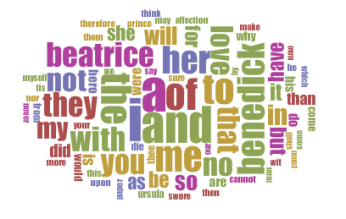
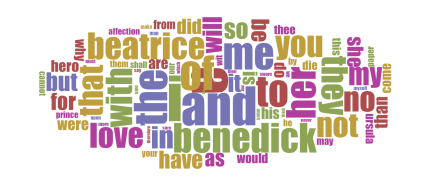
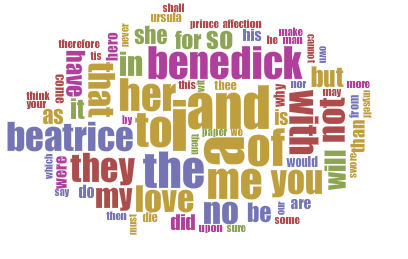
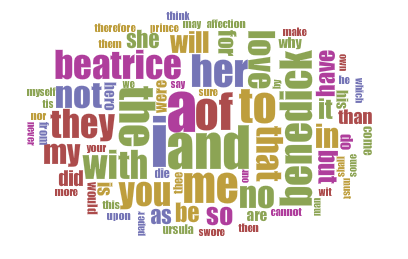
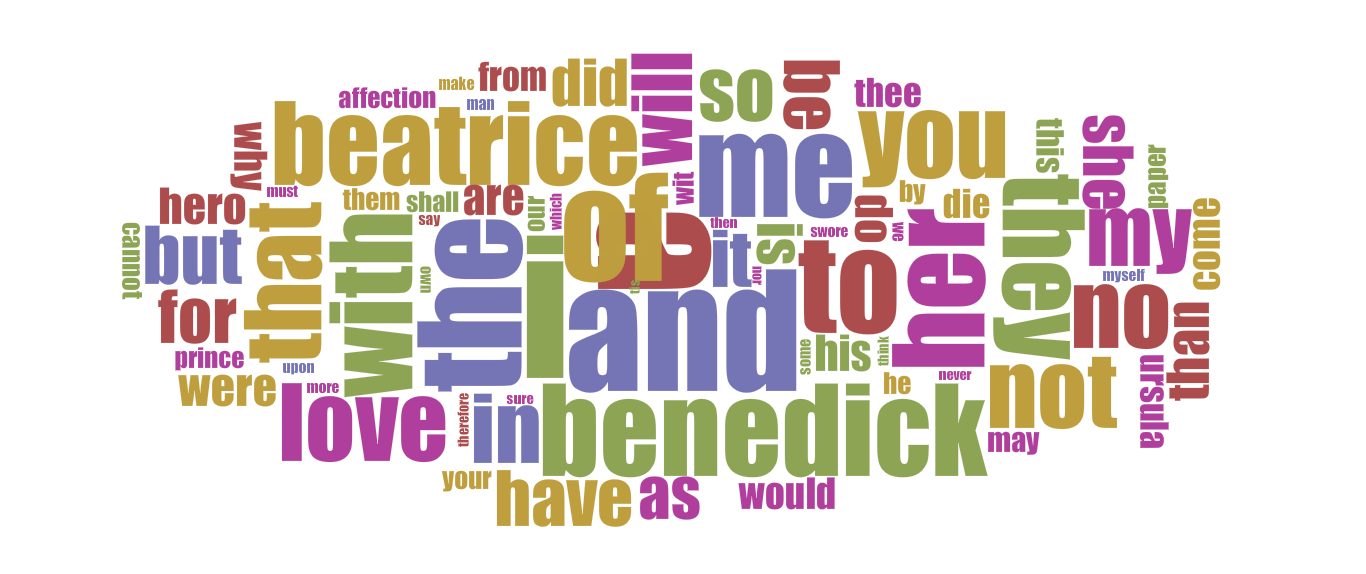
So, since Much Ado About Nothing is now my favorite Shakespearean play, I decided to try experimenting with a condensed version of Benedick’s and Beatrice’s love story. Here are the results via Voyant and Coggle:

Benedick and Beatrice Love Story 2


Benedick and Beatrice Love Story 3Benedick and Beatrice Love Story 4


Note that in all four word bubbles, Benedick and Beatrice are most prominent. This is due to the frequent mention of their names within the diaglogue, but also because they were frequent speakers, and I chose to keep the speakers’ denotations. The next prominent word that jumps out at me is love, which is befitting of a love story. Many of the words are simple connecting words, conjunctions and such, that appear often in any sort of text. However, I do see a significant amount of pronouns: me, my, she, her, they, and you. I didn’t notice this preponderance while reading through the text itself, searching for key scenes that were quite memorable in the movie.

Benedick_and_Beatrice_A_Love_Story_Condensed

(This is a PDF of a weird, branching visualization of several key scenes of Much Ado About Nothing)

I don’t know that these exercises have allowed me to encounter Shakespeare in a new way, necessarily… I think being able to hear the words come alive in theatrical and film versions has really changed the way I view Shakespeare, particularly in Much Ado About Nothing, which has opened my mind to adaptations of these classics. Before now, I sought out the most “accurate” re-tellings of these stories, if such a thing even exists, but my desire to see my favorite actors and director put on this play (Joss Whedon’s 2012 version of the same title) allowed me the opportunity to watch a Shakespeare play in a completely new light.

I encourage you to explore new ways into Shakespeare — it is well worth the effort!


Here is the text I used to create these visualizations. It is a a set of scenes that represent the three stages of their courtship: absolute denial, dishonest love (love by way of trickery, with the best of intentions), and true love. The last line is probably my favorite of the whole play. Oh, the irony. 😉

Benedick’s and Beatrice’s Love Story: The Condensed Version

BENEDICK

That a woman conceived me, I thank her;

that she brought me up, I likewise give her most

humble thanks. But that I will have a recheat

winded in my forehead or hang my bugle in an

invisible baldrick, all women shall pardon me.

Because I will not do them the wrong to mistrust

any, I will do myself the right to trust none. And the

fine is, for the which I may go the finer, I will live a

bachelor.

PRINCE

I shall see thee, ere I die, look pale with love.

BENEDICK

With anger, with sickness, or with hunger,

my lord, not with love. Prove that ever I lose more

blood with love than I will get again with drinking,

pick out mine eyes with a ballad-maker’s pen and

hang me up at the door of a brothel house for the

sign of blind Cupid.


LEONATO

Well, niece, I hope to see you one day fitted

with a husband.

BEATRICE

Not till God make men of some other metal

than earth. Would it not grieve a woman to be

overmastered with a piece of valiant dust? To make

an account of her life to a clod of wayward marl?

No, uncle, I’ll none. Adam’s sons are my brethren,

and truly I hold it a sin to match in my kindred.


BENEDICK

This can be no trick. The

conference was sadly borne; they have the truth of

this from Hero; they seem to pity the lady. It seems

her affections have their full bent. Love me? Why, it

must be requited! I hear how I am censured. They

say I will bear myself proudly if I perceive the love

come from her. They say, too, that she will rather

die than give any sign of affection. I did never think

to marry. I must not seem proud. Happy are they

that hear their detractions and can put them to

mending. They say the lady is fair; ’tis a truth, I can

bear them witness. And virtuous; ’tis so, I cannot

reprove it. And wise, but for loving me; by my troth,

it is no addition to her wit, nor no great argument of

her folly, for I will be horribly in love with her! I

may chance have some odd quirks and remnants of

wit broken on me because I have railed so long

against marriage, but doth not the appetite alter? A

man loves the meat in his youth that he cannot

endure in his age. Shall quips and sentences and

these paper bullets of the brain awe a man from the

career of his humor? No! The world must be peopled.

When I said I would die a bachelor, I did not

think I should live till I were married. Here comes

Beatrice. By this day, she’s a fair lady. I do spy some

marks of love in her.


URSULA

But are you sure

That Benedick loves Beatrice so entirely?

HERO

So says the Prince and my new-trothèd lord.

URSULA

And did they bid you tell her of it, madam?

HERO

They did entreat me to acquaint her of it,

But I persuaded them, if they loved Benedick,

To wish him wrestle with affection

And never to let Beatrice know of it.

URSULA

Why did you so? Doth not the gentleman

Deserve as full as fortunate a bed

As ever Beatrice shall couch upon?

HERO

O god of love! I know he doth deserve

As much as may be yielded to a man,

But Nature never framed a woman’s heart

Of prouder stuff than that of Beatrice.

Disdain and scorn ride sparkling in her eyes,

Misprizing what they look on, and her wit

Values itself so highly that to her

All matter else seems weak. She cannot love,

Nor take no shape nor project of affection,

She is so self-endeared.

URSULA

Sure, I think so,

And therefore certainly it were not good

She knew his love, lest she’ll make sport at it.

HERO

No, not to be so odd and from all fashions

As Beatrice is cannot be commendable.

But who dare tell her so? If I should speak,

She would mock me into air. O, she would laugh

me

Out of myself, press me to death with wit.

Therefore let Benedick, like covered fire,

Consume away in sighs, waste inwardly.

It were a better death than die with mocks,

Which is as bad as die with tickling.


BENEDICK

Soft and fair, friar.—Which is Beatrice?

BEATRICE

I answer to that name. What is your will?

BENEDICK

Do not you love me?

BEATRICE

Why no, no more than reason.

BENEDICK

Why then, your uncle and the Prince and Claudio

Have been deceived. They swore you did.

BEATRICE

Do not you love me?

BENEDICK

Troth, no, no more than reason.

BEATRICE

Why then, my cousin, Margaret, and Ursula

Are much deceived, for they did swear you did.

BENEDICK

They swore that you were almost sick for me.

BEATRICE

They swore that you were well-nigh dead for me.

BENEDICK

’Tis no such matter. Then you do not love me?

BEATRICE

No, truly, but in friendly recompense.

LEONATO

Come, cousin, I am sure you love the gentleman.

CLAUDIO

And I’ll be sworn upon ’t that he loves her,

For here’s a paper written in his hand,

A halting sonnet of his own pure brain,

Fashioned to Beatrice. He shows a paper.

HERO

And here’s another,

Writ in my cousin’s hand, stol’n from her pocket,

Containing her affection unto Benedick.

She shows a paper.

BENEDICK A miracle! Here’s our own hands against

our hearts. Come, I will have thee, but by this light

I take thee for pity.

BEATRICE I would not deny you, but by this good day, I

yield upon great persuasion, and partly to save your

life, for I was told you were in a consumption.

BENEDICK

Peace! I will stop your mouth.

They kiss.

BENEDICK

Come, come, we are friends. Let’s have a

dance ere we are married, that we may lighten our

own hearts and our wives’ heels.

LEONATO

We’ll have dancing afterward.

BENEDICK

First, of my word! Therefore play, music.—

Prince, thou art sad. Get thee a wife, get thee a wife.

Shakespeare in Community: End of Course Self-Reflection

Although I have yet to post reflections on Much Ado About Nothing and The Tempest because I am still digesting the material and swirling it around in my brain, I have completed the “End of Course Self-Reflection” for Shakespeare in Community, which offers prompts to consider about the learning experience thus far. I’ve included these thoughts here, but check back for reflections and assignments specific to the last two plays of the course.

(Sneak peek: I shall write a passionately positive, biased, review on Joss Whedon’s version of Much Ado About Nothing starring Amy Acker as Beatrice and Alexis Denisof as Benedick… It is biased because I’ve held the director and actors in high regard for years, so I went into the film expecting greatness, and even my expectations were exceeded!)

Without further delay, I present my “End of Course Self-Reflection”:

“Reflect on your own encounters with Shakespeare during the second two weeks of this course. What new things have you learned about Shakespeare? What discoveries have you made? Consider also the challenges you’ve faced and how you worked to overcome them?”

The more I delve into Shakespeare, in this course and in the film and play adaptations, the more I come to appreciate, and dare I say, love it. The videos in the course and the posts for each play have been immensely useful to help me wrap my head around complicated plots, themes, and characters. Before, when I would seek out a production of Shakespeare, I would look for something that would be as similar to what I would see in Shakespeare’s time. That has its own value, of course, hence my enjoyment at watching random plays at Renaissance Faires, which are in true form to the 16th century (i.e. VERY interactive with the audience). However, it was my viewing of Much Ado About Nothing that completely swept me away. I was determined to see Joss Whedon’s version because of the director and the cast, particularly Alexis Denisof and Amy Acker. I knew, on that alone, I would enjoy the film. However, I was surprised that the adaptation was quite modern – I can’t even place it… 1920’s, perhaps? The modern adaptation and the decision to film in black and white took nothing away from Shakespeare’s original work, as I always suspected such adaptations would. I even related more to the characters, immersed myself in the plot, and troubled much less over the words. I shall not judge new versions of Shakespeare on their closeness to his original writing, as there are many versions of the “originals” as well, as I have learned in this course. My eyes have been opened to a whole new literary world!

“Write about the work you’ve done for this course. Include one or more links to examples of your work. (You can link to the work itself, if you shared it on the web, or to a Forum post or Facebook thread where you talk about the work.) Discuss the evolution of your work from the first half of the course to the second half. How were your encounters with the first two plays different from your encounters with the second two? Did your own work and responses to the plays also evolve? Link to a discussion forum (or one of your own posts) that felt especially rich to you. Feel free to cut and paste specific sentences, if there are lines you wrote that you’re especially proud of.

Consider your work on the final project. How did you tackle or adapt the assignment? How do you feel about your own accomplishment? Link to it here, if possible, or just talk about the choices you made.”

I feel, with each new assignment and reflection that I post on my blog, http://www.literaryfaerie.com, I come to understand Shakespeare a little better; I see past the words to the story, yet I appreciate the words on their own terms. For example, I found that I understand the whole of the work by watching it as a play or a film, which has helped me get beyond the words I struggle with. Yet, the assignments force me to look at the words and dissect them, study them, and see what jumps out at me. When I wrote a poem based on “A Midsummer Night’s Dream”, which I posted to my blog, I first printed out many verses that stood out to me for certain words or their content, in general. I was more attracted to the phrasing of words than to some of the words themselves, so I played around with them. I used the phrasing, but out of context or said by different characters, to change their meaning, yet keep the lyricism. It was fun and quite the experiment. I’ve enjoyed looking at Shakespeare with fresh eyes, rather than just critically analyzing the literature, which I’ve also written on my blog for each play we’ve sampled and have done so in every study of Shakespeare throughout my schooling. I have been more excited for each activity and reflection as we have progressed into the course. The activities truly are experimental, which is what I strive to do in my blog – to travel outside my comfort zone to experience something new, for myself and for my readers. I have yet to tackle the final project. I am a bit intimidated because it is a video reproduction of one of our plays in some form, but I am also enthusiastic at the prospect. I know it will enrich my creativity even more so than this course already has. I will undoubtedly post it on my blog, http://www.literaryfaerie.com, as well as to my twitter account, @literaryfaerie. There are also links to my various assignments and thoughts on twitter, as well – some I’ve reshared with @hackshakespeare and/or #moocspeare, as a kind of quote from my blog tweet, but I have written original content on that twitter account, as well, so I can share my insights as they occur to me. This has been the most interactive course I’ve taken through Coursera, despite the lack of tests or required assignments and peer assessments. The freedom of expression for exploring Shakespeare is in stark contrast to the dreary study of it often found in traditional classrooms. I could not speak higher of my regard for this course.

“Finally, the questions that began the film series made for the course: Why do we need Shakespeare? What is Shakespeare for?

And the questions from the final film: Why do we need the humanities? What are the humanities for?”

As a student of the humanities, I find the second question easier to answer than the first, but I’ll give it a shot. We need Shakespeare like we need all great artists, whether they share with us the written word, an aesthetic for the eyes, or the sounds of a musician. Shakespeare commented on his everyday life, but he also wrote with themes that transcend time, characters that we can relate with to this day, and he wrote with beautiful prose, verse, and lyricism, which, albeit, may be hard to understand today because the language has changed as it always does, but it is worth the effort to hear the beauty in his words. There is more magic in those words than reading them on a page, and as a writer, I didn’t think I would ever admit that. The past few years, I have given more credit to other mediums than in the past. As a child, I valued the “book” over anything else. I still collect books of all kinds. Yet, plays have interaction — you are literally “there” with the actors — and films can provide special effects and scenery that we may not have even been able to imagine for ourselves. Films can transport us to other worlds because they are created by others — we see into the mind’s eye of our fellow human beings, more so than what our minds can conjure on their own. Everyone sees and observes something different in their surroundings because no one person’s perspective is the same, which is why literature and art can be interpreted in numerous ways. We interpret the world with the power of our past and the scope of our imaginations. We put our mark on this world in many formats, and there are infinite possibilities if we are willing to share our vulnerabilities and have courage. Shakespeare is an integral part of the humanities for his genius and his wit, no more or less so than Chaucer or Oscar Wilde or Sophocles or J.K. Rowling. They all add to our cultural understanding, our pure enjoyment, and our appreciation for life itself. We step outside our own little pedestrian world and follow some grand adventure, get our adrenaline running, and imagine what couldn’t be imagined. The humanities, and the arts in particular, have, in many ways, inspired science (think of all the advances made on account of science fiction), and science has brought us into a future, undoubtedly unbelievable to those of Shakespeare’s time. Yet, his themes ring true many centuries later, as I hope, artists of today can inspire future generations.