Benedick and Beatrice: A Love Story Condensed

For this assignment in Shakespeare in Community, we were given many tools to try to find different ways into the text:

“This week’s text lectures have considered the way a Shakespeare play moves from one medium to another…For the assignment this week, we encourage you to look at what else individual words can tell us, either in Much Ado About Nothing or in one of the other plays in this course. What words stand out when you close read the text on your own? What words stand out when you use a digital tool to visualize the words or to look at them from a distance?”

“The goal for this assignment is not to make something or break something, but to experiment with at least one tool you haven’t used and to see how it might help you encounter Shakespeare in a new way.”

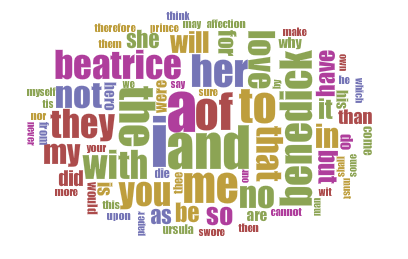
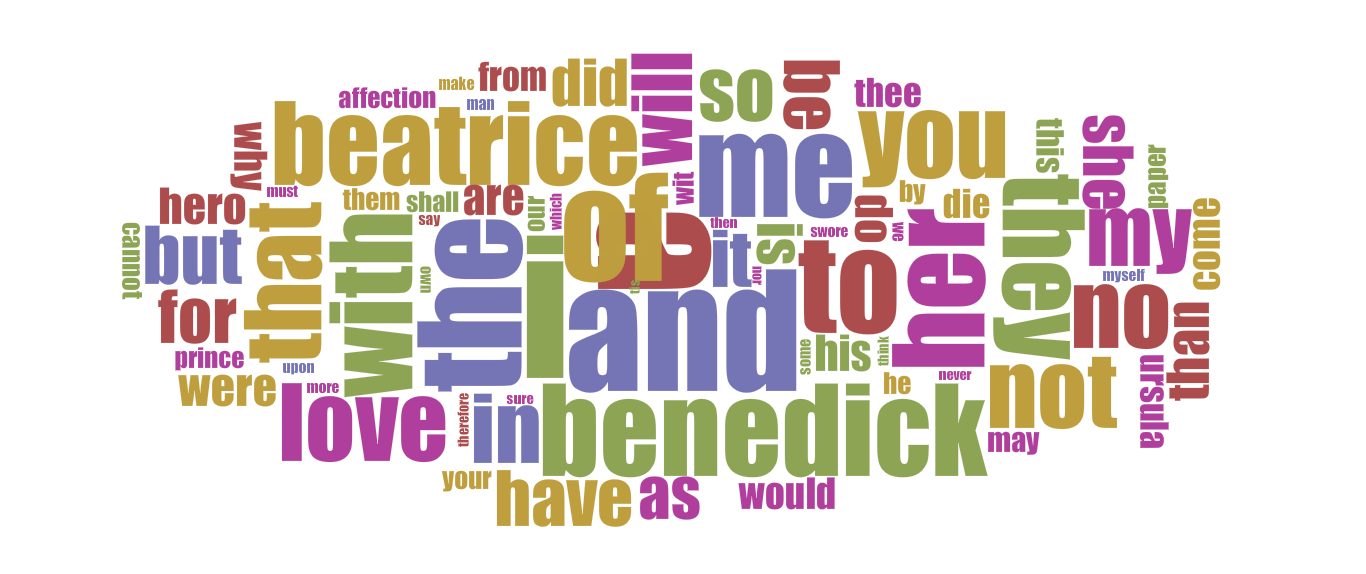
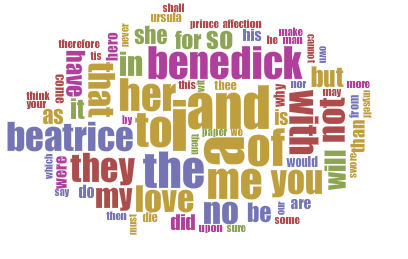
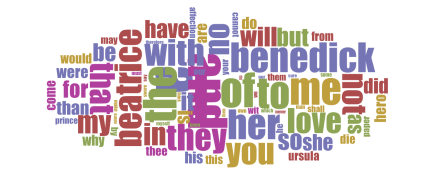
So, since Much Ado About Nothing is now my favorite Shakespearean play, I decided to try experimenting with a condensed version of Benedick’s and Beatrice’s love story. Here are the results via Voyant and Coggle:
Benedick and Beatrice Love Story 2


Benedick and Beatrice Love Story 3Benedick and Beatrice Love Story 4


Note that in all four word bubbles, Benedick and Beatrice are most prominent. This is due to the frequent mention of their names within the diaglogue, but also because they were frequent speakers, and I chose to keep the speakers’ denotations. The next prominent word that jumps out at me is love, which is befitting of a love story. Many of the words are simple connecting words, conjunctions and such, that appear often in any sort of text. However, I do see a significant amount of pronouns: me, my, she, her, they, and you. I didn’t notice this preponderance while reading through the text itself, searching for key scenes that were quite memorable in the movie.

Benedick_and_Beatrice_A_Love_Story_Condensed

(This is a PDF of a weird, branching visualization of several key scenes of Much Ado About Nothing)

I don’t know that these exercises have allowed me to encounter Shakespeare in a new way, necessarily… I think being able to hear the words come alive in theatrical and film versions has really changed the way I view Shakespeare, particularly in Much Ado About Nothing, which has opened my mind to adaptations of these classics. Before now, I sought out the most “accurate” re-tellings of these stories, if such a thing even exists, but my desire to see my favorite actors and director put on this play (Joss Whedon’s 2012 version of the same title) allowed me the opportunity to watch a Shakespeare play in a completely new light.

I encourage you to explore new ways into Shakespeare — it is well worth the effort!


Here is the text I used to create these visualizations. It is a a set of scenes that represent the three stages of their courtship: absolute denial, dishonest love (love by way of trickery, with the best of intentions), and true love. The last line is probably my favorite of the whole play. Oh, the irony. 😉

Benedick’s and Beatrice’s Love Story: The Condensed Version

BENEDICK

That a woman conceived me, I thank her;

that she brought me up, I likewise give her most

humble thanks. But that I will have a recheat

winded in my forehead or hang my bugle in an

invisible baldrick, all women shall pardon me.

Because I will not do them the wrong to mistrust

any, I will do myself the right to trust none. And the

fine is, for the which I may go the finer, I will live a

bachelor.

PRINCE

I shall see thee, ere I die, look pale with love.

BENEDICK

With anger, with sickness, or with hunger,

my lord, not with love. Prove that ever I lose more

blood with love than I will get again with drinking,

pick out mine eyes with a ballad-maker’s pen and

hang me up at the door of a brothel house for the

sign of blind Cupid.


LEONATO

Well, niece, I hope to see you one day fitted

with a husband.

BEATRICE

Not till God make men of some other metal

than earth. Would it not grieve a woman to be

overmastered with a piece of valiant dust? To make

an account of her life to a clod of wayward marl?

No, uncle, I’ll none. Adam’s sons are my brethren,

and truly I hold it a sin to match in my kindred.


BENEDICK

This can be no trick. The

conference was sadly borne; they have the truth of

this from Hero; they seem to pity the lady. It seems

her affections have their full bent. Love me? Why, it

must be requited! I hear how I am censured. They

say I will bear myself proudly if I perceive the love

come from her. They say, too, that she will rather

die than give any sign of affection. I did never think

to marry. I must not seem proud. Happy are they

that hear their detractions and can put them to

mending. They say the lady is fair; ’tis a truth, I can

bear them witness. And virtuous; ’tis so, I cannot

reprove it. And wise, but for loving me; by my troth,

it is no addition to her wit, nor no great argument of

her folly, for I will be horribly in love with her! I

may chance have some odd quirks and remnants of

wit broken on me because I have railed so long

against marriage, but doth not the appetite alter? A

man loves the meat in his youth that he cannot

endure in his age. Shall quips and sentences and

these paper bullets of the brain awe a man from the

career of his humor? No! The world must be peopled.

When I said I would die a bachelor, I did not

think I should live till I were married. Here comes

Beatrice. By this day, she’s a fair lady. I do spy some

marks of love in her.


URSULA

But are you sure

That Benedick loves Beatrice so entirely?

HERO

So says the Prince and my new-trothèd lord.

URSULA

And did they bid you tell her of it, madam?

HERO

They did entreat me to acquaint her of it,

But I persuaded them, if they loved Benedick,

To wish him wrestle with affection

And never to let Beatrice know of it.

URSULA

Why did you so? Doth not the gentleman

Deserve as full as fortunate a bed

As ever Beatrice shall couch upon?

HERO

O god of love! I know he doth deserve

As much as may be yielded to a man,

But Nature never framed a woman’s heart

Of prouder stuff than that of Beatrice.

Disdain and scorn ride sparkling in her eyes,

Misprizing what they look on, and her wit

Values itself so highly that to her

All matter else seems weak. She cannot love,

Nor take no shape nor project of affection,

She is so self-endeared.

URSULA

Sure, I think so,

And therefore certainly it were not good

She knew his love, lest she’ll make sport at it.

HERO

No, not to be so odd and from all fashions

As Beatrice is cannot be commendable.

But who dare tell her so? If I should speak,

She would mock me into air. O, she would laugh

me

Out of myself, press me to death with wit.

Therefore let Benedick, like covered fire,

Consume away in sighs, waste inwardly.

It were a better death than die with mocks,

Which is as bad as die with tickling.


BENEDICK

Soft and fair, friar.—Which is Beatrice?

BEATRICE

I answer to that name. What is your will?

BENEDICK

Do not you love me?

BEATRICE

Why no, no more than reason.

BENEDICK

Why then, your uncle and the Prince and Claudio

Have been deceived. They swore you did.

BEATRICE

Do not you love me?

BENEDICK

Troth, no, no more than reason.

BEATRICE

Why then, my cousin, Margaret, and Ursula

Are much deceived, for they did swear you did.

BENEDICK

They swore that you were almost sick for me.

BEATRICE

They swore that you were well-nigh dead for me.

BENEDICK

’Tis no such matter. Then you do not love me?

BEATRICE

No, truly, but in friendly recompense.

LEONATO

Come, cousin, I am sure you love the gentleman.

CLAUDIO

And I’ll be sworn upon ’t that he loves her,

For here’s a paper written in his hand,

A halting sonnet of his own pure brain,

Fashioned to Beatrice. He shows a paper.

HERO

And here’s another,

Writ in my cousin’s hand, stol’n from her pocket,

Containing her affection unto Benedick.

She shows a paper.

BENEDICK A miracle! Here’s our own hands against

our hearts. Come, I will have thee, but by this light

I take thee for pity.

BEATRICE I would not deny you, but by this good day, I

yield upon great persuasion, and partly to save your

life, for I was told you were in a consumption.

BENEDICK

Peace! I will stop your mouth.

They kiss.

BENEDICK

Come, come, we are friends. Let’s have a

dance ere we are married, that we may lighten our

own hearts and our wives’ heels.

LEONATO

We’ll have dancing afterward.

BENEDICK

First, of my word! Therefore play, music.—

Prince, thou art sad. Get thee a wife, get thee a wife.

Shakespeare in Community: End of Course Self-Reflection

Although I have yet to post reflections on Much Ado About Nothing and The Tempest because I am still digesting the material and swirling it around in my brain, I have completed the “End of Course Self-Reflection” for Shakespeare in Community, which offers prompts to consider about the learning experience thus far. I’ve included these thoughts here, but check back for reflections and assignments specific to the last two plays of the course.

(Sneak peek: I shall write a passionately positive, biased, review on Joss Whedon’s version of Much Ado About Nothing starring Amy Acker as Beatrice and Alexis Denisof as Benedick… It is biased because I’ve held the director and actors in high regard for years, so I went into the film expecting greatness, and even my expectations were exceeded!)

Without further delay, I present my “End of Course Self-Reflection”:

“Reflect on your own encounters with Shakespeare during the second two weeks of this course. What new things have you learned about Shakespeare? What discoveries have you made? Consider also the challenges you’ve faced and how you worked to overcome them?”

The more I delve into Shakespeare, in this course and in the film and play adaptations, the more I come to appreciate, and dare I say, love it. The videos in the course and the posts for each play have been immensely useful to help me wrap my head around complicated plots, themes, and characters. Before, when I would seek out a production of Shakespeare, I would look for something that would be as similar to what I would see in Shakespeare’s time. That has its own value, of course, hence my enjoyment at watching random plays at Renaissance Faires, which are in true form to the 16th century (i.e. VERY interactive with the audience). However, it was my viewing of Much Ado About Nothing that completely swept me away. I was determined to see Joss Whedon’s version because of the director and the cast, particularly Alexis Denisof and Amy Acker. I knew, on that alone, I would enjoy the film. However, I was surprised that the adaptation was quite modern – I can’t even place it… 1920’s, perhaps? The modern adaptation and the decision to film in black and white took nothing away from Shakespeare’s original work, as I always suspected such adaptations would. I even related more to the characters, immersed myself in the plot, and troubled much less over the words. I shall not judge new versions of Shakespeare on their closeness to his original writing, as there are many versions of the “originals” as well, as I have learned in this course. My eyes have been opened to a whole new literary world!

“Write about the work you’ve done for this course. Include one or more links to examples of your work. (You can link to the work itself, if you shared it on the web, or to a Forum post or Facebook thread where you talk about the work.) Discuss the evolution of your work from the first half of the course to the second half. How were your encounters with the first two plays different from your encounters with the second two? Did your own work and responses to the plays also evolve? Link to a discussion forum (or one of your own posts) that felt especially rich to you. Feel free to cut and paste specific sentences, if there are lines you wrote that you’re especially proud of.

Consider your work on the final project. How did you tackle or adapt the assignment? How do you feel about your own accomplishment? Link to it here, if possible, or just talk about the choices you made.”

I feel, with each new assignment and reflection that I post on my blog, http://www.literaryfaerie.com, I come to understand Shakespeare a little better; I see past the words to the story, yet I appreciate the words on their own terms. For example, I found that I understand the whole of the work by watching it as a play or a film, which has helped me get beyond the words I struggle with. Yet, the assignments force me to look at the words and dissect them, study them, and see what jumps out at me. When I wrote a poem based on “A Midsummer Night’s Dream”, which I posted to my blog, I first printed out many verses that stood out to me for certain words or their content, in general. I was more attracted to the phrasing of words than to some of the words themselves, so I played around with them. I used the phrasing, but out of context or said by different characters, to change their meaning, yet keep the lyricism. It was fun and quite the experiment. I’ve enjoyed looking at Shakespeare with fresh eyes, rather than just critically analyzing the literature, which I’ve also written on my blog for each play we’ve sampled and have done so in every study of Shakespeare throughout my schooling. I have been more excited for each activity and reflection as we have progressed into the course. The activities truly are experimental, which is what I strive to do in my blog – to travel outside my comfort zone to experience something new, for myself and for my readers. I have yet to tackle the final project. I am a bit intimidated because it is a video reproduction of one of our plays in some form, but I am also enthusiastic at the prospect. I know it will enrich my creativity even more so than this course already has. I will undoubtedly post it on my blog, http://www.literaryfaerie.com, as well as to my twitter account, @literaryfaerie. There are also links to my various assignments and thoughts on twitter, as well – some I’ve reshared with @hackshakespeare and/or #moocspeare, as a kind of quote from my blog tweet, but I have written original content on that twitter account, as well, so I can share my insights as they occur to me. This has been the most interactive course I’ve taken through Coursera, despite the lack of tests or required assignments and peer assessments. The freedom of expression for exploring Shakespeare is in stark contrast to the dreary study of it often found in traditional classrooms. I could not speak higher of my regard for this course.

“Finally, the questions that began the film series made for the course: Why do we need Shakespeare? What is Shakespeare for?

And the questions from the final film: Why do we need the humanities? What are the humanities for?”

As a student of the humanities, I find the second question easier to answer than the first, but I’ll give it a shot. We need Shakespeare like we need all great artists, whether they share with us the written word, an aesthetic for the eyes, or the sounds of a musician. Shakespeare commented on his everyday life, but he also wrote with themes that transcend time, characters that we can relate with to this day, and he wrote with beautiful prose, verse, and lyricism, which, albeit, may be hard to understand today because the language has changed as it always does, but it is worth the effort to hear the beauty in his words. There is more magic in those words than reading them on a page, and as a writer, I didn’t think I would ever admit that. The past few years, I have given more credit to other mediums than in the past. As a child, I valued the “book” over anything else. I still collect books of all kinds. Yet, plays have interaction — you are literally “there” with the actors — and films can provide special effects and scenery that we may not have even been able to imagine for ourselves. Films can transport us to other worlds because they are created by others — we see into the mind’s eye of our fellow human beings, more so than what our minds can conjure on their own. Everyone sees and observes something different in their surroundings because no one person’s perspective is the same, which is why literature and art can be interpreted in numerous ways. We interpret the world with the power of our past and the scope of our imaginations. We put our mark on this world in many formats, and there are infinite possibilities if we are willing to share our vulnerabilities and have courage. Shakespeare is an integral part of the humanities for his genius and his wit, no more or less so than Chaucer or Oscar Wilde or Sophocles or J.K. Rowling. They all add to our cultural understanding, our pure enjoyment, and our appreciation for life itself. We step outside our own little pedestrian world and follow some grand adventure, get our adrenaline running, and imagine what couldn’t be imagined. The humanities, and the arts in particular, have, in many ways, inspired science (think of all the advances made on account of science fiction), and science has brought us into a future, undoubtedly unbelievable to those of Shakespeare’s time. Yet, his themes ring true many centuries later, as I hope, artists of today can inspire future generations.


Breaking Dreams For Love

“For this activity, you’ll break something as an act of literary analysis. Choose a selection of words from A Midsummer Night’s Dream and rearrange them into something else. You can use any or all of the words as many or as few times as you’d like. What you build from them can take any shape: text, image, video, a collage, a poem, a pile, digital, physical, sense-making or otherwise… For this assignment, you will borrow ideas but you should also make them truly your own—by playing with, manipulating, applying, and otherwise turning them on their head.”

A love story that is NOT a love story, turned on its head, is a love story. Thus, this is my version of “breaking stuff”:


PROLOGUE

Shakespeare tells a tale of woe –

Of betrayal, hate, confusion, and spite.

This story of love is but a farce,

For love is made a mockery of:

Unrequited, illusioned, forbidden in the night.

Here protest I in love’s favor!

Not a comedy, but a tragic labor:

So go!

Hence you be soothed

In fairies’ soft light.


ONE

Fickle Demetrius proclaims, “I cannot love you” to fair Helena,

Yet she, in earnest, doth proclaim “I love you the more”

I will fawn on you, give me only leave to follow you.”

“How can dost love Hermia whilst you gave your love to me?

I shall change the story, as the dove now pursues the griffin.

The wildest creature doth not compare to thee or have your heart

As you have mine.”

Oh, the forgeries of jealousy!


When true lovers have ever been star-crossed,

Is it destiny or some other force,

Playing a scene on the stage of life?


Lysander, in defiance of gentle Hermia’s tyrannical father’s wishes

Asks “May I Marry Thee?”

“Steal forth from thy father’s home, into the wood.”

Hermia doth swearest her deepest vow:

“By Venus’ doves, by Cupid’s bow,

By all the vows which knitteth souls and prospers loves –

Tomorrow truly will I meet with thee.”


Oh, the night approaches…

And Hermia recalls to Lysander,

“In the wood where you and I

Were wont to lie

Upon faint primrose beds,

We shall meet,

Until then, we starve our sight

Till morrow deep midnight.”


TWO

In the darkest hours, the fairies play,

In forests, and meads, by paved fountains,

By rushy brooks – where there is nature, there are fairies.

“Let us dance our ringlets in the whistling wind and

Sing our sweet lullabies:


Lulla, lulla, lullaby,

Come not near our Fairy Queen

Never harm, nor spell or charm,

Our lovely lady, have thee peaceful slumber,

Lulla, lulla, lullaby,

Good night, sweet Queen,

This melody spells good night.


Waxen in their mirth,

The fairies away…

And that knavish sprite,

Robin Goodfellow, known as Puck,

Creates mischief in the woods.

“I, a merry wanderer of the night,

Jest to Oberon and attest to make things right.”


Asleep in the woods,

Lysander and his beloved, hiding from the Court,

Helena and her prey, the man who once loved her.

“These human mortals fall in the fresh lap of the crimson rose;

Sweet summer buds adorn the couples

As the moon washes the air of this ‘mazed world.”

Robin reflects, “This flower’s force in stirring love, long forgotten…

But here lies the maiden, sleeping sound on the dank and dirty ground.

Pretty soul, this charm doth owe…”

Sweet Puck anoints the eyelids of Demetrius, to right the wrong he committed.


THREE

Awake, they all, as daylight abates.

“Sweet Helena,” Demetrius praises.

My goddess, my love, divine and rare!”

“Do you mock me? To proclaim love to the unloved?” Helena asks with disdain.

Demetrius begs at her feet, “Tis you, my love, that I hast forgot…

Tender me, forsooth, with affection!

My heart is yours; one heart we can make of it

If we shall be interchained with an oath.”

“How I do quake with fear, if this but be a dream… I swoon with fear!” Helena exclaims.


“Heavens shield us gentle lovers with the break of day,” pleads Hermia.

“Alak, Lysander, where are you? No sound, no word?”

“Fear not, my precious Hermia.

Take thee at my innocence, for I was lost in the woods.”


By Nature’s hand, dew drops rest on crimson petals

And daylight shines through the forest canopy.

Nymphs and fairies hide away to sleep soundly.


From his palace, the Duke brings sweet peace.

With Demetrius desirous of Hermia no more,

Lysander is free to marry his beloved with blessings of the Court.

This eve, they shall blessed be,

And ever true in loving be.


EPILOGUE

All is mended, and tragedy avoided, which is a lover’s dream intended.


*This poem, though an original work of my own, borrows many lines, verbatim, from “A Midsummer Night’s Dream” by William Shakespeare. The lines have been altered in context, and in some cases, spoken by different characters, but nevertheless, the lyrical language is owed only to the great Bard.

*I read from the Folger Shakespeare Library for this edition of “A Midsummer Night’s Dream”:

http://www.folgerdigitaltexts.org

A Midsummer Night’s Dream Is NOT A Love Story

Never before had I read or watched A Midsummer Night’s Dream until this morning. Despite some plot and theme preparation from my Shakespeare in Community MOOC, I still managed to hold onto preconceptions that a play about love and faeries would be, well, happy… and magical.

It took me a scene or two to familiarize myself with the characters, particularly because in this play, Puck was played simultaneously by a man and a woman (or so I suppose). While I was relegated to watch a movie version of Romeo and Juliet, I lucked out and found a theatrical production of MSND. In fact, the playbill read:

Harvard-Radcliffe Summer Theatre presents William Shakespeare’s A Midsummer Night’s Dream. Summer 2007 stage production featuring the music of Felix Mendelssohn.

With no surprise, the actors, the sets, and the accuracy of Shakespeare’s language were all of the highest quality. I could have been transported to the Globe Theatre in England, were I not aware of my surroundings. I imagined myself sitting in the theatre during a live performance, which was authenticated as audience members occasionally, unwittingly, stepped in front of the camera, thus momentarily obscuring my view. There was an unbearably long (mere minutes), and oddly placed, intermission, and the orchestra was brilliant. My “seat” was far closer than if I attended the performance in person, so YouTube does have its benefits.

The mechanics of the performance aside, the content of the play truly caught me off-guard. I had no prior exposure to this play in any entirety (not counting a Disney show’s parody, which, in hindsight, did not cast much light on the subject, now that I have seen the actual play), so I experienced every word, every action, every confusing and infuriating moment for the first time. These were fresh emotions and reactions to a Shakespearean play, which I have not felt in many years, since other Shakespearean works have reappeared often throughout my life.

For a play about love, and it is, sort of, in many varied forms, MSND has much hatred, callousness, whining, degradation, and scorn – and that’s before the faeries make their mischief! My utmost surprise came at the lack of love toward Hermia by her father, Egeus. He is despicable and treats his daughter like dirt. Meanwhile, Helena basically harasses Demetrius and even asked him to treat her as his dog (literally) if only he allowed her to love him. She is desperate and crass, loud and rude. After the night’s confusion, Demetrius does come to love her (probably by spell, but since he did mention that he loved her when they were children, it’s possible that his love still exists), yet Helena pulls him down the aisle and must keep his attention during their brief ceremony. It is quite painful to watch. Hermia seems a sweet spirit, with no obvious faults, yet she is repeatedly abused by all the mortal men, including her father and especially during Lysander and Demetrius’ duel. I believe she is the most deserving of the term “victim”.

Finally, to end a very odd play indeed, is the “play within a play”, which is the most ridiculous thing I have ever witnessed, even if it was meant to be a farce. I was put off by the harsh comments of the audience (particularly the Duke) made during the play, even criticizing the actors in earshot and to their faces. Was this the norm in Shakespeare’s time or was this of his own imagining? Hippolyta seems utterly disgusted with her “lover”, Theseus, the Duke of Athens, and rather annoyed at the whole process of betrothal. Her responses to her own wedding and general bitchiness make me want to reread some of my Greek mythology to see why she carries this attitude. Was she forced into the marriage? Of course, the play does not address this; in fact, the Duke and his bride are minor characters in terms of time on stage.

Watching the play in theatre format made me feel part of the performance, but movie versions do have their place – for one thing, the audience is less distracting. Either medium is an exceptional way to see one of Shakespeare’s plays come to life. As we discussed this week in my course, Shakespeare’s plays have been translated into many languages and people even watch them without speaking the language of the land, so my aversion to Shakespeare for not understanding the “King’s English” seems rather arbitrary. And yes, naysayers will emphasize that Shakespeare often wrote and “borrowed” stories that were based on others’ work, such as folklore and poetry, rather than write completely original content, but he made the stories his own, which is what any good writer does. (Lord of the Rings has many mythological references, as does Star Wars, because the themes transcend time.) He used his skillful language, but more than that, he brings these stories to the “Every Man” even today because all patrons of his art can relate in some way to the themes and the powerful emotions. If you can follow a play without understanding the language, then one must think this is due to brilliant acting, directing, and of course, playwriting.

Finally, note that while Romeo and Juliet begins with love and ends in tragedy and A Midsummer Night’s Dream begins with tragedy and ends in “love”, I would attest that truer love is present between Romeo and Julietand the real tragedy lies in the seemingly happy, yet blissfully ignorant, lives of the newlyweds, and even more so, the adulterous Faerie Queen and the spiteful Faerie King.

*As quoted by the director of the production, Joshua Randall, in regard to Puck: “We thought of them as two halves of the same Puck rather than two Pucks. The main reason was because we wanted Puck to be able to explicitly express both female and male characteristics. Since the character of Puck is somewhat androgynous, many modern productions choose to have Puck played by a woman. However, in this production we were highlighting the gender roles and therefore did not want to choose only male or only female characteristics for Puck.”

The funniest scene in Romeo & Juliet as a “Word Cloud”

Romeo & Juliet Act 1, Scene 1 
SAMPSON My naked weapon is out. Quarrel, I will back
thee.
GREGORY How? Turn thy back and run?
SAMPSON Fear me not.
GREGORY No, marry. I fear thee!
SAMPSON Let us take the law of our sides; let them
begin.
GREGORY I will frown as I pass by, and let them take it
as they list.
SAMPSON Nay, as they dare. I will bite my thumb at
them, which is disgrace to them if they bear it.
editorial emendationHe bites his thumb.editorial emendation
ABRAM Do you bite your thumb at us, sir?
SAMPSON I do bite my thumb, sir.
ABRAM Do you bite your thumb at us, sir?
SAMPSON,editorial emendationaside to Gregoryeditorial emendation Is the law of our side if I
say “Ay”?
GREGORY,editorial emendationaside to Sampsoneditorial emendation No.
SAMPSON No, sir, I do not bite my thumb at you, sir,
but I bite my thumb, sir.
GREGORY Do you quarrel, sir?
ABRAM Quarrel, sir? No, sir.
SAMPSON But if you do, sir, I am for you. I serve as
good a man as you.
ABRAM No better.
SAMPSON Well, sir.

Enter Benvolio.

GREGORY,editorial emendationaside to Sampsoneditorial emendation Say “better”; here comes
one of my master’s kinsmen.
SAMPSON Yes, better, sir.
ABRAM You lie.
SAMPSON Draw if you be men.—Gregory, remember
thy washing blow.They fight.
BENVOLIO Part, fools!editorial emendationDrawing his sword.editorial emendation
Put up your swords. You know not what you do.


Midterm Self-Reflection for Shakespeare in Community

I’ve had some profound insights as I reflected on my experiences thus far with Shakespeare, so I thought I would share them here. They are personal to me, but if you are seeking out your own Shakespeare, I encourage you to ask yourself these questions after awhile. It may bring your own abstract ideas into focus.

“Reflect on your own encounters with Shakespeare leading up to and within the first two weeks of this course. What have you learned about Shakespeare? What discoveries have you made?”

I never knew Shakespeare until this course. That is, to say, I’ve read several plays of his, but avoided reading Shakespeare whenever possible because I could not understand the language of the day. I didn’t understand why Shakespeare was read and revered all these centuries later. The first assignment, to write my own words about Shakespeare’s words, was confusing and disconcerting at first. Then, as I thought about it, I began to write, and I began to appreciate the importance of first words, and I began to appreciate Shakespeare. Still, I struggled with the language while attempting to read Shakespeare’s Romeo and Juliet. I was so determined, but I could not see the forest for the trees. I got caught up on deciphering the meaning of every word I didn’t know that I lost sight of what was happening. After considering the guest lecturers’ input that Shakespeare should be spoken aloud and performed, I decided to watch a play on YouTube. There, I was able to see the emotion, the fury, the desperation, the love, the youth – everything I had been missing by concentrating on the words. As I followed the plot and characters with more ease, I noticed that I could appreciate those Shakespearean words for their beauty and eloquence, for which I never could before.

“Write about the work you have done for this course. Include one or more links to examples of your work. You can link to work in the discussion forum or work that you’ve done elsewhere on the web (videos you’ve made, blog posts you’ve written, Tweets, Facebook threads you’ve contributed to, etc.) Reflect briefly on the what, why, and how of the work that you’ve done.”

*Note that even if you are not involved with Coursera or the Shakespeare in Community MOOC (both of which I highly recommend), you can still get involved in discussions on Facebook and Twitter with the hashtag #MOOCspeare and the account @hackshakespeare. You will indeed find lively discussions from others around the world!

I have a literary blog where I post my own writing, reviews, critical analyses, and various musings. I decided to use this outlet to express my thoughts on my experience with Shakespeare. It has worked delightfully well because it is a medium I am comfortable with and can write at any length about any discoveries I have made. My blog, http://www.literaryfaerie.com, also links to my Tumber account, “Rebecca’s Tumblr, Yay!”, my personal facebook page, and my twitter account, @literaryfaerie, thus my audience is expanded beyond my blog. When I first set out to write my ideas on my blog, I introduced the course and invited readers to participate in the various prompts and experience Shakespeare for themselves. I have included #MOOCspeare as a tag for each post. I will continue to post in this manner, but I would also like to try the “twitter essay” and respond in the discussion forum more often, as I have not posted much in the forum as of yet. My work has reflected on my experiences, frustrations, insights, and creativity while discussing Shakespeare. I am a writer at heart, so my blog posts read as stories, I believe. Each post on http://www.literaryfaerie.com regarding this course has Shakespeare in the title, is accessible on the first page, and is tagged with #MOOCspeare. As I said, these posts are also linked to twitter, so you may find them there, as well, although I don’t know how to link specific tweets.

“What are your goals for the second half of this MOOC. What conversations do you hope to have? What do you hope to build, make, write?”

My goals initially were to understand the language of Shakespeare, so I could read his work and be part of the academic world that hails Shakespeare, instead of feeling like a blasphemer for disliking reading his plays. My goals have since changed. I understand Shakespeare to be like a foreign language to me – it will take years of study for the language to become second nature to me, for me not to need to look up nearly every word or phrase. This is not necessary to understand Shakespeare’s plays at their essence, only to dissect and analyze them. First, I need to develop an appreciation for these works. I need to look past the words to the sights, sounds, actions, emotions, and characters of the plays to really FEEL the story. Only then is my mind free to hone in on the lyricism and beauty of the words that are spoken. Plays were meant to be performed. Honestly, every play I’ve ever seen, I enjoyed immensely because of the immersive atmosphere. So, instead of “reading” Shakespeare, I am going to seek out performances of each of the plays we’re studying, and then, if I need a reference, I will look to my books and other resources. I think I’ve found this is the way to My Shakespeare.

I refrained from answering the latter part of that question, mostly because at this point, I don’t know. I’m just excited to have finally found a way to relate to Shakespeare. 🙂

Discovering the Joy of Shakespeare, or For the Love of Romeo and Juliet

I’ve been studying Romeo and Juliet for some time now. Of course, I know the main plot points – it’s been parodied countless times in countless art forms, and I read the play, with much instruction, during my freshmen year of high school. Yet, as I took up the book again, I found myself stymied by the language. I could not behold the grandeur of the vocabulary, as so many fans of the Bard seem to attest. As someone with Obsessive-Compulsive Disorder and Asperger’s, whenever I read anything – whether intellectual or not, I reread each sentence at least twice, sometimes more. This makes me a slow reader, but an excellent analyst of literature. However, when trying to understand the whole of a Shakespearean work, one cannot just concentrate on the meaning of every single word. Looking at footnotes and dictionaries frequently while attempting to read the play disrupts the natural rhythm of the play.

Sure, for intensive study of Romeo and Juliet, or any other play by any other playwright for that matter, understanding the nuances of the language, the double meanings, or the lost meanings from Elizabethan times to our own, is essential. As I’ve learned in my Shakespeare in Community course, this understanding likely came naturally to the original audiences of Shakespeare’s plays. Language is fluid, though; it changes with each generation. Reading work that may be a hundred years old, or 600 years old, or one thousand years old is like reading a different language. One studies the grammar and syntax of a foreign language, immersing oneself in the culture and spoken words, before one has enough mastery to read a book in that language and understand it as second nature.

As a writer, I was determined that I should read this play, rather than watch the play performed, as if that was somehow cheating. But I was so fixated on every word I didn’t understand, I was getting nowhere fast. Finally, I relented. I watched the 1976 version of Romeo and Juliet. Immediately, I saw and heard things that I just couldn’t pick up by reading. I love literary analysis and enjoy it immensely, but how can I analyze something I don’t fundamentally understand at its core. I only knew this play as if looking through tiny peepholes in a fence, missing the wholeness of the work. Shakespeare is a different language to me: I needed to watch the reactions of the characters, their movements, their facial expressions; I needed to hear the laughter (I never knew there was so much joviality in the first acts! I read those lines as stoic, not recognizing a goodhearted jest between friends) to appreciate the story behind the words. It was as if watching and listening to the action without focusing on understanding every word provided me with subtitles to each scene, allowing me not only to get the gist of what was happening, but also to finally hear those beautiful, passionate, unbridled words. The play came alive! With whispers and shouts and declarations of love, crying vehemently and vows of rage-filled revenge – I couldn’t insert these emotions into my reading because I was hung up on just understanding the vocabulary.

Now, for the first time, I observed Romeo, Juliet, and their family and friends as teenagers. The duels between Mercutio and Tybalt were most likely caused by the hormones coursing through their bodies, coupled with the feud between the two houses that those boys may not have even fully understood. While Mercutio antagonizes, Tybalt remains bull-headed. Blows were bound to be had, but over-zealous teenagers armed with weaponry, and it’s no wonder that disaster struck. I was more drawn in by the injustice and the sadness of young life lost during senseless battles than I was by the love and lust between Juliet and her Romeo that intensified as each act progressed. Only as I watched them kiss passionately before their wedding ceremony did I realize how in love they were. Until then, I only saw Juliet as a child of 14 – naive, willing to do whatever her mother asked of her, sweet and innocent. Romeo and Benvolio tried to keep the peace among the houses, but alas, poor Romeo was bested by circumstances (and Tybalt’s bull-headedness). This is not the play I read as a 14 year old, focused on these weird, outdated words and listening to lectures just to understand what this darn story was about.

Shakespeare was a playwright. His works are meant to be performed in the theatre. I love books in all their glory, but now I will approach plays as plays and not as books. The message seems to get lost in the translation.

Shakespeare: First words

Here is my first assignment. Feel free to respond or to answer the prompt in your own way, either on my blog or on @hackshakespeare:

“Choose first words from one of the plays we will be discussing, and write about them some of your own first words.”

         Two households, both alike in dignity

~ Romeo and Juliet

Now, fair Hippolyta, our nuptial hour / Draws on apace

          ~ A Midsummer Night’s Dream

I learn in this letter

~ Much Ado About Nothing

MASTER Boatswain!
BOATSWAIN Here, master. What cheer?

~ The Tempest

“Don’t fret about whether you’ve read the rest of the play or not. Take the words “at their word,” so to speak. What do they mean to you? What do they make you think of? Do the words create pictures in your mind? Do the words appeal to your senses of smell and touch and taste as well as to sight and sound? If so, which senses are activated in you by these words? Where do they send your imagination? What kind of excitement, trepidation, or confusion do they unfurl in you?”

First words… First words hold unbelievable importance, whether they are the first words of a first chapter, in which you make a snap, almost subconscious, decision to read that book or place it back on the shelf, or whether they are the first words a young child speaks. Such emphasis! So much to live up to. How does the blank page ever become filled when we cannot decide on the perfect first words? Yet, Shakespeare not only conquers this fear – he is renowned for his selection of words, his mastery of language, his ability to manipulate, postulate, confuse, excite… the list goes on and on.

So, for my first words about Shakespeare’s first words, I choose “I learn in this letter”. I confess, I have not yet read Much Ado About Nothing so I have no frame of reference for this quote. Perhaps that is a good thing. I was drawn to this quote because of the word, “letter”. I immediately pictured in my mind’s eye a piece of old parchment with a flowing script that was scratched onto it by a quill dipped in an inkwell. As a writer, how could I not be drawn to these words? The imagery of days past, when we wrote in beautiful calligraphy on golden parchment to communicate great ideas or to simply invite a relative for a stay at our humble abode. Now people write by way of technological resources, which certainly have their place in society, but they are cold, uncaring. The clickety-click of typing on a keyboard is so far removed from writing furiously with pen and paper until your hand begins to cramp because you can’t get your ideas out fast enough. There is magic in paper. Perhaps because, in some small way, we are still connected to nature. After all, that paper once came from a tree. It had a life, even after death, as pulp (I learned to make paper from a craft kit as a child, and I still hold that experience dear), and eventually it came to us, crisp and blank. The blank page can be scary, but it also represents freedom. Anything is possible in that moment. Paper is also fragile. If left out in the sun, the paper yellows. The sign of a good book is a wrinkled, worn spine. Imagine how miraculous it is that any books have survived over centuries of war, strife, fires, rain, or other ruinous events. Some works are simply lost to the ages. Have you ever smelled an old book? Walked the stacks of an enormous library until you became lost among the books? I have. Those experiences are endangered. I don’t need to know right now what is in that letter of Shakespeare’s. I appreciate its existence.

Engaging with William Shakespeare

I have never sought out Shakespeare’s works intentionally. In fact, I think it’s safe to say I avoid them. I know – as a writer, this is blasphemy! Though I love the time period and frequent the Renaissance Faire every summer, the language of the time has always left me frustrated. How can I appreciate a play if I don’t understand the plot’s intricacies? The nuances? The double meanings that echo throughout all of Shakespeare’s works?

I decided enough was enough. No longer would I shirk from Shakespeare. His works survived centuries for a reason, right? I enrolled in a Coursera free course entitled “Shakespeare in Community”, which can also be found on Facebook and on twitter at @hackshakespeare. I invite you to join the discussions in those forums. Perhaps we can all learn something from the Bard.

Anyway, I’ll be posting my observations here. Most will undoubtedly be in response to prompts given in the short course, but feel free to answer the questions yourself. I am bringing Shakespeare to you by way of UW-Madison’s purposely chaotic Coursera course, which encourages us that this is no one entrance into Shakespeare, and there is no ending to Shakespeare, as we continue to revisit his works and learn new things each time. This is not an attempt to “study” Shakespeare, as we would do in traditional courses, but to “discover” our own Shakespeare.