
For this assignment in Shakespeare in Community, we were given many tools to try to find different ways into the text:
“This week’s text lectures have considered the way a Shakespeare play moves from one medium to another…For the assignment this week, we encourage you to look at what else individual words can tell us, either in Much Ado About Nothing or in one of the other plays in this course. What words stand out when you close read the text on your own? What words stand out when you use a digital tool to visualize the words or to look at them from a distance?”
“The goal for this assignment is not to make something or break something, but to experiment with at least one tool you haven’t used and to see how it might help you encounter Shakespeare in a new way.”
So, since Much Ado About Nothing is now my favorite Shakespearean play, I decided to try experimenting with a condensed version of Benedick’s and Beatrice’s love story. Here are the results via Voyant and Coggle:
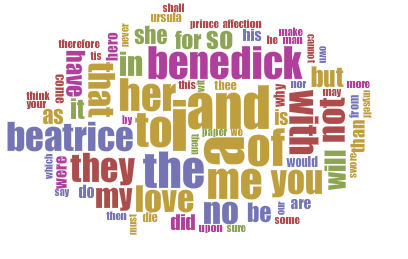
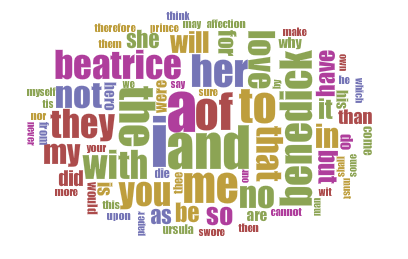
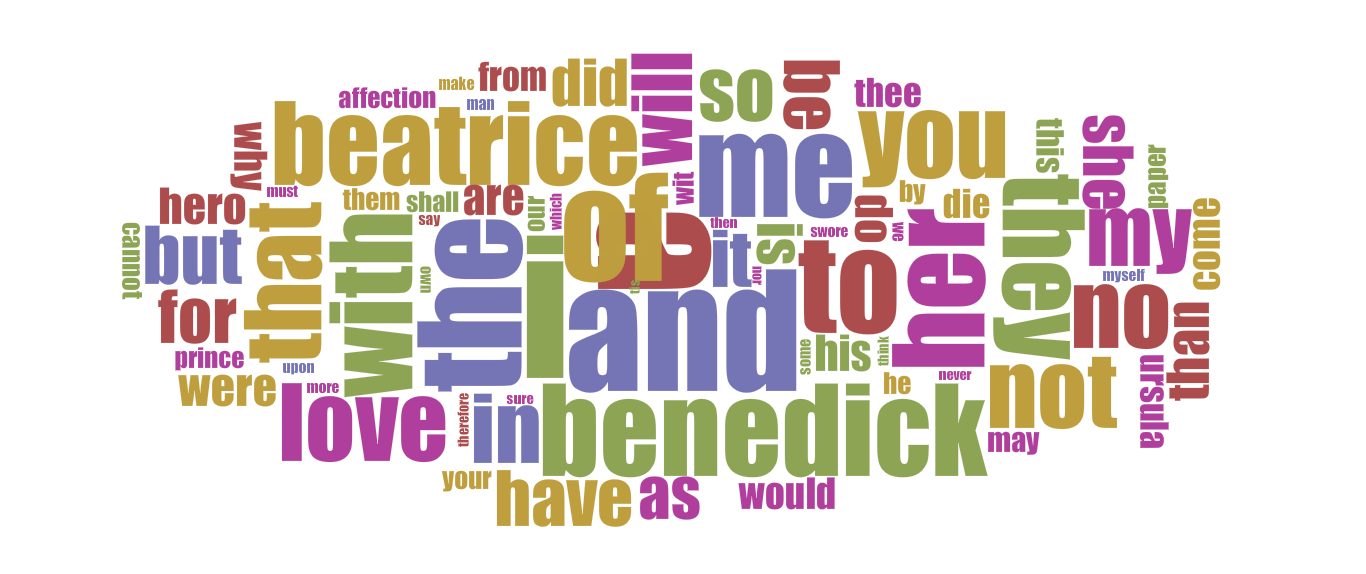
Note that in all four word bubbles, Benedick and Beatrice are most prominent. This is due to the frequent mention of their names within the diaglogue, but also because they were frequent speakers, and I chose to keep the speakers’ denotations. The next prominent word that jumps out at me is love, which is befitting of a love story. Many of the words are simple connecting words, conjunctions and such, that appear often in any sort of text. However, I do see a significant amount of pronouns: me, my, she, her, they, and you. I didn’t notice this preponderance while reading through the text itself, searching for key scenes that were quite memorable in the movie.
Benedick_and_Beatrice_A_Love_Story_Condensed
(This is a PDF of a weird, branching visualization of several key scenes of Much Ado About Nothing)
I don’t know that these exercises have allowed me to encounter Shakespeare in a new way, necessarily… I think being able to hear the words come alive in theatrical and film versions has really changed the way I view Shakespeare, particularly in Much Ado About Nothing, which has opened my mind to adaptations of these classics. Before now, I sought out the most “accurate” re-tellings of these stories, if such a thing even exists, but my desire to see my favorite actors and director put on this play (Joss Whedon’s 2012 version of the same title) allowed me the opportunity to watch a Shakespeare play in a completely new light.
I encourage you to explore new ways into Shakespeare — it is well worth the effort!
Here is the text I used to create these visualizations. It is a a set of scenes that represent the three stages of their courtship: absolute denial, dishonest love (love by way of trickery, with the best of intentions), and true love. The last line is probably my favorite of the whole play. Oh, the irony. 😉
Benedick’s and Beatrice’s Love Story: The Condensed Version
BENEDICK
That a woman conceived me, I thank her;
that she brought me up, I likewise give her most
humble thanks. But that I will have a recheat
winded in my forehead or hang my bugle in an
invisible baldrick, all women shall pardon me.
Because I will not do them the wrong to mistrust
any, I will do myself the right to trust none. And the
fine is, for the which I may go the finer, I will live a
bachelor.
PRINCE
I shall see thee, ere I die, look pale with love.
BENEDICK
With anger, with sickness, or with hunger,
my lord, not with love. Prove that ever I lose more
blood with love than I will get again with drinking,
pick out mine eyes with a ballad-maker’s pen and
hang me up at the door of a brothel house for the
sign of blind Cupid.
LEONATO
Well, niece, I hope to see you one day fitted
with a husband.
BEATRICE
Not till God make men of some other metal
than earth. Would it not grieve a woman to be
overmastered with a piece of valiant dust? To make
an account of her life to a clod of wayward marl?
No, uncle, I’ll none. Adam’s sons are my brethren,
and truly I hold it a sin to match in my kindred.
BENEDICK
This can be no trick. The
conference was sadly borne; they have the truth of
this from Hero; they seem to pity the lady. It seems
her affections have their full bent. Love me? Why, it
must be requited! I hear how I am censured. They
say I will bear myself proudly if I perceive the love
come from her. They say, too, that she will rather
die than give any sign of affection. I did never think
to marry. I must not seem proud. Happy are they
that hear their detractions and can put them to
mending. They say the lady is fair; ’tis a truth, I can
bear them witness. And virtuous; ’tis so, I cannot
reprove it. And wise, but for loving me; by my troth,
it is no addition to her wit, nor no great argument of
her folly, for I will be horribly in love with her! I
may chance have some odd quirks and remnants of
wit broken on me because I have railed so long
against marriage, but doth not the appetite alter? A
man loves the meat in his youth that he cannot
endure in his age. Shall quips and sentences and
these paper bullets of the brain awe a man from the
career of his humor? No! The world must be peopled.
When I said I would die a bachelor, I did not
think I should live till I were married. Here comes
Beatrice. By this day, she’s a fair lady. I do spy some
marks of love in her.
URSULA
But are you sure
That Benedick loves Beatrice so entirely?
HERO
So says the Prince and my new-trothèd lord.
URSULA
And did they bid you tell her of it, madam?
HERO
They did entreat me to acquaint her of it,
But I persuaded them, if they loved Benedick,
To wish him wrestle with affection
And never to let Beatrice know of it.
URSULA
Why did you so? Doth not the gentleman
Deserve as full as fortunate a bed
As ever Beatrice shall couch upon?
HERO
O god of love! I know he doth deserve
As much as may be yielded to a man,
But Nature never framed a woman’s heart
Of prouder stuff than that of Beatrice.
Disdain and scorn ride sparkling in her eyes,
Misprizing what they look on, and her wit
Values itself so highly that to her
All matter else seems weak. She cannot love,
Nor take no shape nor project of affection,
She is so self-endeared.
URSULA
Sure, I think so,
And therefore certainly it were not good
She knew his love, lest she’ll make sport at it.
HERO
No, not to be so odd and from all fashions
As Beatrice is cannot be commendable.
But who dare tell her so? If I should speak,
She would mock me into air. O, she would laugh
me
Out of myself, press me to death with wit.
Therefore let Benedick, like covered fire,
Consume away in sighs, waste inwardly.
It were a better death than die with mocks,
Which is as bad as die with tickling.
BENEDICK
Soft and fair, friar.—Which is Beatrice?
BEATRICE
I answer to that name. What is your will?
BENEDICK
Do not you love me?
BEATRICE
Why no, no more than reason.
BENEDICK
Why then, your uncle and the Prince and Claudio
Have been deceived. They swore you did.
BEATRICE
Do not you love me?
BENEDICK
Troth, no, no more than reason.
BEATRICE
Why then, my cousin, Margaret, and Ursula
Are much deceived, for they did swear you did.
BENEDICK
They swore that you were almost sick for me.
BEATRICE
They swore that you were well-nigh dead for me.
BENEDICK
’Tis no such matter. Then you do not love me?
BEATRICE
No, truly, but in friendly recompense.
LEONATO
Come, cousin, I am sure you love the gentleman.
CLAUDIO
And I’ll be sworn upon ’t that he loves her,
For here’s a paper written in his hand,
A halting sonnet of his own pure brain,
Fashioned to Beatrice. He shows a paper.
HERO
And here’s another,
Writ in my cousin’s hand, stol’n from her pocket,
Containing her affection unto Benedick.
She shows a paper.
BENEDICK A miracle! Here’s our own hands against
our hearts. Come, I will have thee, but by this light
I take thee for pity.
BEATRICE I would not deny you, but by this good day, I
yield upon great persuasion, and partly to save your
life, for I was told you were in a consumption.
BENEDICK
Peace! I will stop your mouth.
They kiss.
BENEDICK
Come, come, we are friends. Let’s have a
dance ere we are married, that we may lighten our
own hearts and our wives’ heels.
LEONATO
We’ll have dancing afterward.
BENEDICK
First, of my word! Therefore play, music.—
Prince, thou art sad. Get thee a wife, get thee a wife.
 literaryfaerie
You must be logged in to post a comment.